 Our wine guru Gary Chevsky, back in November 2009, experimented with some Barbera wines from Piemonte:
“Unclear why anyone would want to drink aged Barbera, a wine grape that is associated with easy quaffing and everyday meals. In the land where Nebbiolo is firmly the king, why mess with that? Let Barbera and Dolcetto play their lowly part in the food chain. Affordable, refreshing, satisfyingly easy drinking table wines. What would the world do without them, no?
But of course someone is always ready to challenge status quo, try to make an eagle out of a sparrow, a Boeing out of a paper plane. Treat Dolcetto like a more serious grape, and you get Dolcetto di Dogliani, deeper, richer, more ageable. Treat Barbera like that, and what do you get?
On Monday, a small group of enthusiasts got together at a Ross Bott tasting in Los Altos to assess 1999-2001 Barberas by La Spinetta. La Spinetta has a “standard” or lower-end Ca’ Di Pian wine that costs in the teens, and a higher-end wine that costs $40-50. Having tasted Gaja’s 1995 Barbera “Sitorey” earlier this year and having found it a powerful, fresh, and nuanced wine, my expectations were mixed. After all, that was Gaja! Could anyone else approach that effort?
From the mailer by Ross Bott, the organizer:
“Barbera is the third most planted red grape varietal planted in Italy, after Sangiovese and Montepulciano. Although planted in many of the northern Italian provinces, it is at its best in the Piedmonte region area around Asti, where it has DOCG status, Italy’s highest classification.
The varietal is naturally high in acid and low in tannins, and, when vinified in a lighter style to be drunk young, is a fine everyday wine to complement pastas and other northern Italian dishes. However, when yields are kept low and the grapes are harvested at riper levels, the resultant wines can be deep, complex and long aging, and marry particularly well with new medium toasted (or charred) oak barrels. Ironically, this approach is a relatively recent phenomenon in Piedmonte. In fact, some of the earliest examples of this approach were in the Shennandoah Valley in California, where Montevina made some great old Special Selection Barberas in the late 1970s — to my view the most exciting wines ever to come out of the Sierra Foothills.
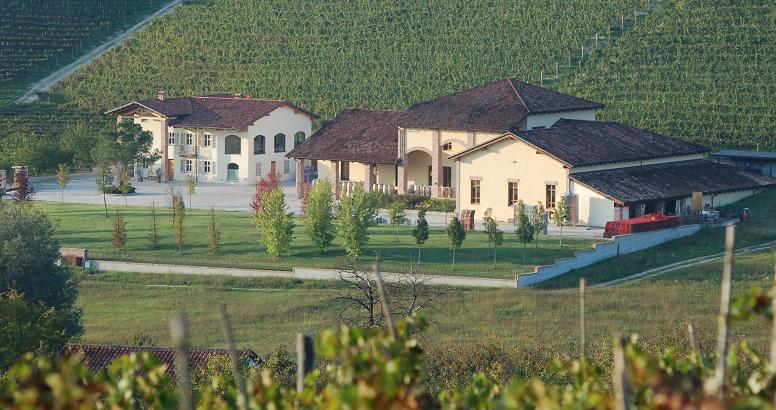
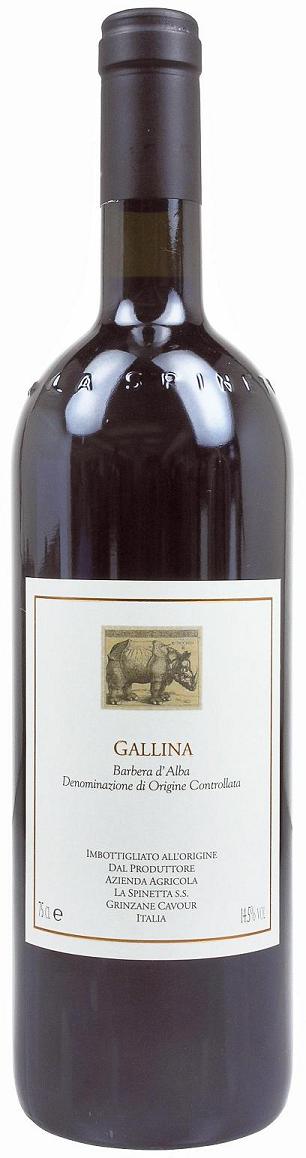
In 1998, Giuseppe Rivetti began to make a Barbera Superiore under his La Spinetta label, a serious, high-end approach involving old vines, low yields, and aging for 12-18 months in new French oak. Rivetti was born in Argentina, but his family was Piedmontese, and he returned in 1977 to the Asti region, in an area then known for Moscato d’Asti, a fragrant, low alcohol wine made from a varietal in the Muscat family. After producing some landmark examples of this white wine, he ventured into reds in 1985, first with Barbera and later adding Barbarescos and Barolos. He produces three Barberas a year, a Ca’ Di Pian which is richer and riper than most Barberas, but sees less oak, a Gallina from a single vineyard which also provides the grapes for his Barbaresco, and a Superiore, which is a reserve bottling from a selection of his best barrels. Both of the latter get extended barrel treatment and are among the three or four best Barberas produced anywhere.
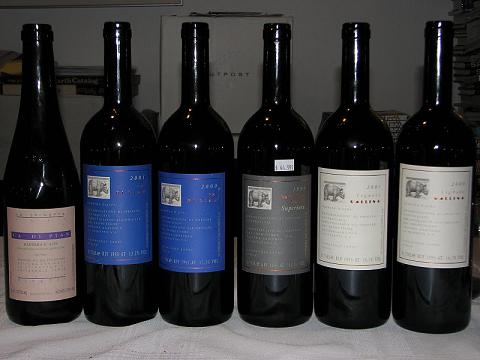
Tonight, we’ll try six La Spinetta Barberas, a pair from each of 1999, 2000 and 2001. One member of each pair will be the lightly oaked Ca’ Di Pian and the other an example of his highest end Barberas which get extended treatment in new oak.”
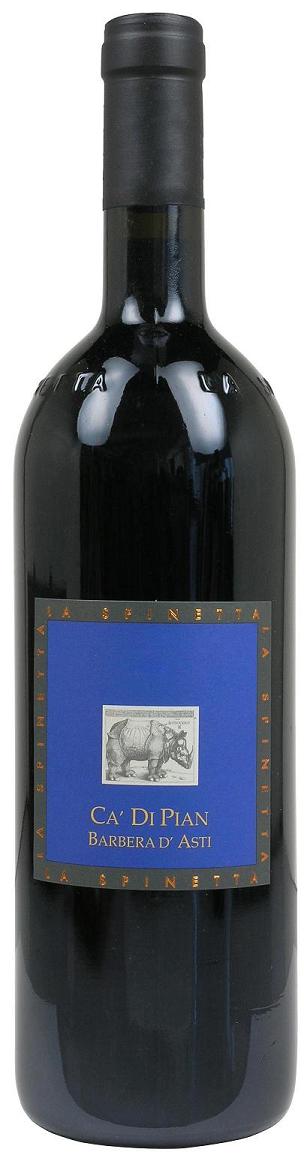
From what La Spinetta I have tasted, it seems to have a ripe fruity style, perhaps closer to new world than old. On the photos below, the wines are ranked right to left in the order of scores. Easily in our blind tasting, the group ruled that more expensive wines beat out the cheaper ones. Though drinkable, the lower-end ones obviously not built for aging were slightly pickled, dusty, and funky. The higher-end “Superiore” and “Gallina” were in perfectly good shape, maintaining fresh fruit.
While the top 3 wines still “showed” young, it is as if they had artificially been beefed up to last longer, and the age did not give them subtlety, complexity, and secondary flavors that I’ve seen develop in properly aged ageworthy wines. It seemed rather pointless to me to spend $45 a bottle, then cellar it for 10 years, when in that range one finds some wonderful Nebbiolo and Sangiovese options. While obviously we confirmed Barbera’s ageability, I would not call that ageworthiness. It bothered me that the wines lacked finesse and complexity, and the question that firmly stuck in my mind was – “What’s the point!???”